
Deck repair and deck building on Long Beach Island and in Barnegat, NJ
Rotted boards, soft spots, loose stairs and railings that move. We repair what can be repaired and rebuild what cannot — with hardware that survives salt air, on a schedule that works around your renters.
(609) 622-5647Free estimates.
10 years on the tools — and the person who quotes your deck is the person standing on it while it gets built.
Long Beach Island and mainland Ocean County. Beach Haven, Ship Bottom, Surf City, Harvey Cedars, Barnegat Light, Brant Beach, Loveladies, Holgate, Beach Haven Terrace, Barnegat, Manahawkin, Stafford Township, Waretown, Forked River, Tuckerton, Little Egg Harbor, Toms River — and everywhere in between.

Alex Vega, owner. Vega Construction LLC, Barnegat, New Jersey.
The contractor you are actually hiring
Alex Vega owns Vega Construction and is on the job himself — ten years in the trade, based in Barnegat and working the island and the mainland around it.
Vega Construction is a small crew, which is the whole point. The person who walks your deck and writes the number is the same person on site while the work happens. Nothing gets handed to whoever was free that week, and nobody gets to blame the last guy for how it came out.
Most of the decks out here fail the same way, and it is almost never the part you can see. Salt air eats the nails and the hangers underneath while the boards on top still look fine. That is why a deck can pass a glance from the kitchen window and still be loose where it counts. We look underneath before we quote anything.
A lot of these houses are rented in the summer, so the owner is not the one who finds the problem — a guest is. We work around that: estimates by photo if you are out of state, progress pictures while the job runs, and scheduling built around when the house is actually empty.
Registered as a home improvement contractor with the New Jersey Division of Consumer Affairs, and insured. The registration number is at the bottom of this page and you can check it yourself in about thirty seconds.
What we do on decks
From replacing a handful of rotted boards to taking the whole thing down and starting over.
Rotted board replacement
Soft boards, splintered boards, the one spot everybody steps around. We pull what has gone and check the joist underneath it, because a board rots from below far more often than from above.
Stairs and steps
We rebuild stringers that have gone soft at the bottom, treads that flex, and a bottom step sitting straight on wet sand. Stairs are where most deck injuries happen and the first thing an inspector looks at — so if that is all that is wrong, say so and we will quote just the stairs.
Railings and guards
A railing you can move with one hand is a railing that is not doing its job. We rebuild the posts and the connections, not just the top rail, and set the guard height the code asks for.
Framing and structural repair
We sister joists, replace beams, and redo a ledger connection that was nailed when it should have been bolted. This is the work nobody sees and the only work that decides whether a deck is safe — and it is itemised in our quote rather than buried in a square-foot price.
Full rebuilds and new decks
When repair stops making sense, we take it down and build back. Wood or composite, single level or two, with the footings dug to depth and the permit pulled before anything goes up.
Everything around the deck
The rotted door frame the deck was hiding, the trim, the siding behind the ledger, the paint when it is done. One crew, one number, instead of chasing three contractors who each blame the other two.
Why decks fail faster out here
The boards are not the problem. The metal holding them together is.
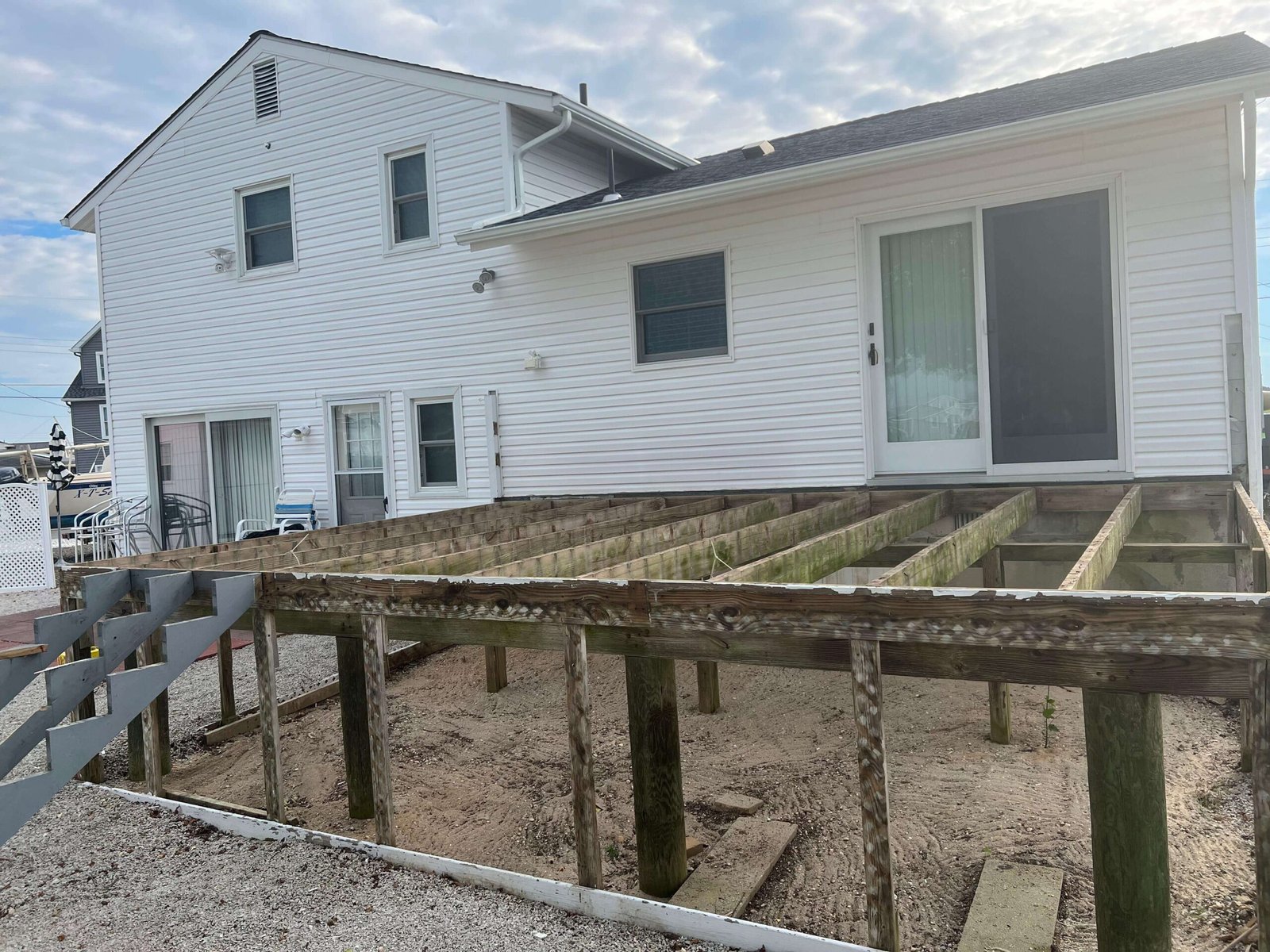
A deck two blocks from the bay lives a completely different life than the same deck twenty miles inland. Salt in the air settles into every joint, and rain keeps those joints wet long enough that they never really dry. Nails give up their coating, then the steel underneath starts going, and the hole around each nail slowly opens up while the wood closest to it softens.
None of that shows from the top. What you see is a deck that looks like it has a few more years in it. What is actually happening is that the connections are letting go one at a time.
This is why the building code treats coastal decks differently. Fasteners and connectors within 300 feet of a saltwater shoreline are required to be stainless steel — not galvanized, not coated. On Long Beach Island that is essentially every house on the island, and on a fair amount of the bayfront mainland too.
It is also the easiest corner in the whole job to cut, because nobody can see hardware once the boards are down. We use what the code calls for, and if we open up your deck and find that the last crew did not, you will see it yourself before we close it back up.
If you see rust bleeding out around the screw heads and it does not wipe off, stop using the deck and call somebody. That is not a cosmetic problem.
If that is what you are looking at right now, call us and we will come and look at it this week at no charge. A deck that is not safe to stand on is not a quote we want sitting in an inbox.
Repair it or replace it
We will tell you which one you are looking at, even when the honest answer is the cheaper one.
Plenty of decks that look finished are not. If the frame underneath is solid and the ledger is attached properly, replacing the decking and the railing gives you what amounts to a new deck for a fraction of what a rebuild costs. We would rather do that job and have you call us again in four years for the painting.
The opposite is also true. If the posts are going at the base, the joists have been wet for years, or the ledger was nailed to the house instead of bolted, there is no repair worth paying for. Putting new boards over a frame that is failing buys you a deck that looks great and is still the same deck.
The only way to know which one you have is from underneath. That is where we start every estimate, and it costs you nothing.
If the deck came with other work around it — a door frame that rotted where the deck met the house, siding behind the ledger, trim, paint — we handle that too rather than sending you to find someone else. That is usually the real reason people put the whole thing off.
Signs it is structural, not cosmetic
- The deck moves when you walk near the railing
- Rust bleeding from screw heads that will not wipe off
- A post you can push a screwdriver into at the base
- Gaps opening where the deck meets the house
- Stair treads that flex under one person
- Boards that stay dark and damp days after rain
If you rent the house out
Most of the decks we work on belong to somebody who does not live there.
A rental deck gets used harder than a family deck and gets looked at less. Ten people on it at once on a Saturday, all summer, and the owner sees it twice a year. By the time anybody notices the problem, it has usually been there a while.
It also sits differently on you legally. In New Jersey a property owner is expected to inspect the property and fix dangerous conditions — the standard is what you knew or should have known. A deck that has been quietly failing for three summers is not something that happened suddenly.
The off season is the whole answer. From October to April the house is empty, nobody is losing booked nights, and we are not working around anyone’s vacation. It is also when we can actually get to a job quickly. Every year the same thing happens: the calls start in April and half of them cannot be finished before Memorial Day weekend.
If you are out of state, that does not change anything. Send photos and we can tell you most of what we need to know, and you will get pictures as the work goes rather than a phone call at the end.
How we work around a rental
Estimates from photos if you are not local. Work scheduled in the off season so no booked weeks are lost. Progress pictures sent as the job runs. And a finish date in writing, so you know the deck is done before the first guest arrives.
What decides the price of a deck job
Everybody wants the number first, and nobody can give it to you honestly over the phone. Here is what it actually turns on.
- Whether the frame is sound. The biggest fork in the road by far. Replacing decking and railing on a good frame is one kind of job. Rebuilding the structure underneath is a completely different one, and only looking from below tells you which you have.
- The hardware the location requires. Close to salt water the connectors and fasteners have to be stainless. It costs more than galvanized and it is the reason the deck is still standing in fifteen years. It is not a place to save.
- How high it is and how many stairs. Height drives the footings, the posts, the bracing and the guard requirements. A deck two feet off the ground and a deck eight feet off the ground are not the same job even at the same square footage.
- Wood or composite. Composite costs more going in and asks almost nothing of you afterward. Wood costs less going in and wants cleaning and sealing on a schedule, which out here is a real commitment. We will walk you through what each one means over the years you plan to keep the house.
- Railing. Often the single most underestimated line on a deck quote. The posts, the connections and the code requirements are most of the work; the rail itself is the easy part.
- Getting to it. Tight side yards, a bayfront lot, a second-story deck, or a house with tenants in it all change how the work gets staged and how long it takes.
The estimate is free and the price is in writing before anything comes apart — what is included, what is not, and what happens if we open something up and find more than we could see. If your deck only needs boards, that is what the quote says, even when a rebuild would have been the bigger sale.
How the job goes
Step 1
We look underneath
Free, on your schedule, and from below — not from the kitchen window. That is where we find out whether you are looking at a repair or a rebuild.
Step 2
Scope and price in writing
What comes out, what goes back, what hardware we are using and what is not included. Plus what happens if we find something once it is open.
Step 3
Permit if the job needs one
New Jersey requires a permit for new and replacement decks. We pull it and we meet the inspector, so that is not something you have to manage.
Step 4
We build it
Same crew start to finish, the site cleaned at the end of each day, and photos as it goes if you are not in town. We walk it with you before it is called done.
Coming out to look at the deck is free and there is no obligation after. Call (609) 622-5647, or send photos — one from a distance, one of the worst board, and one underneath if you can get there — and we will tell you whether you are looking at a repair or a rebuild.
Recent work
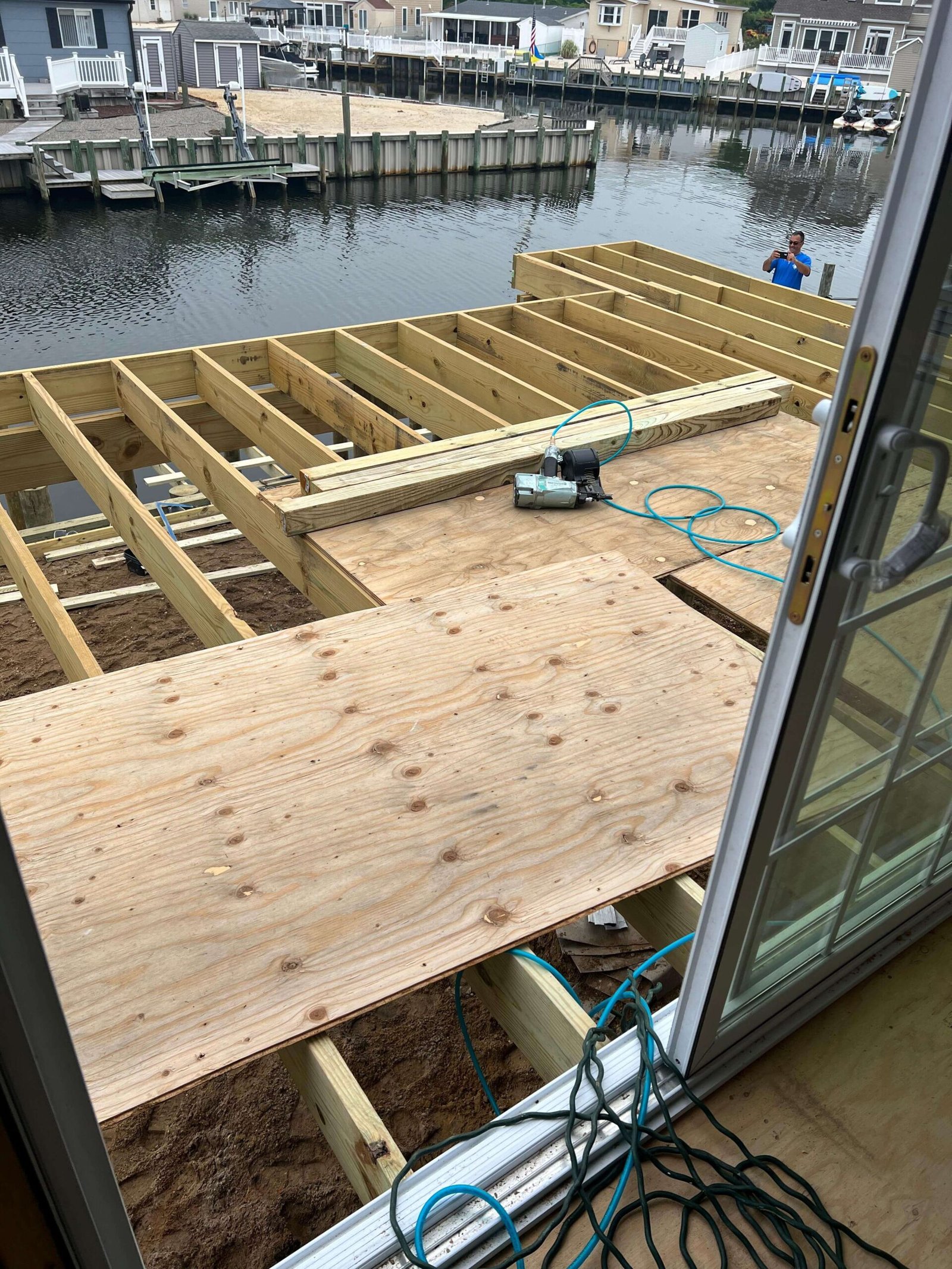
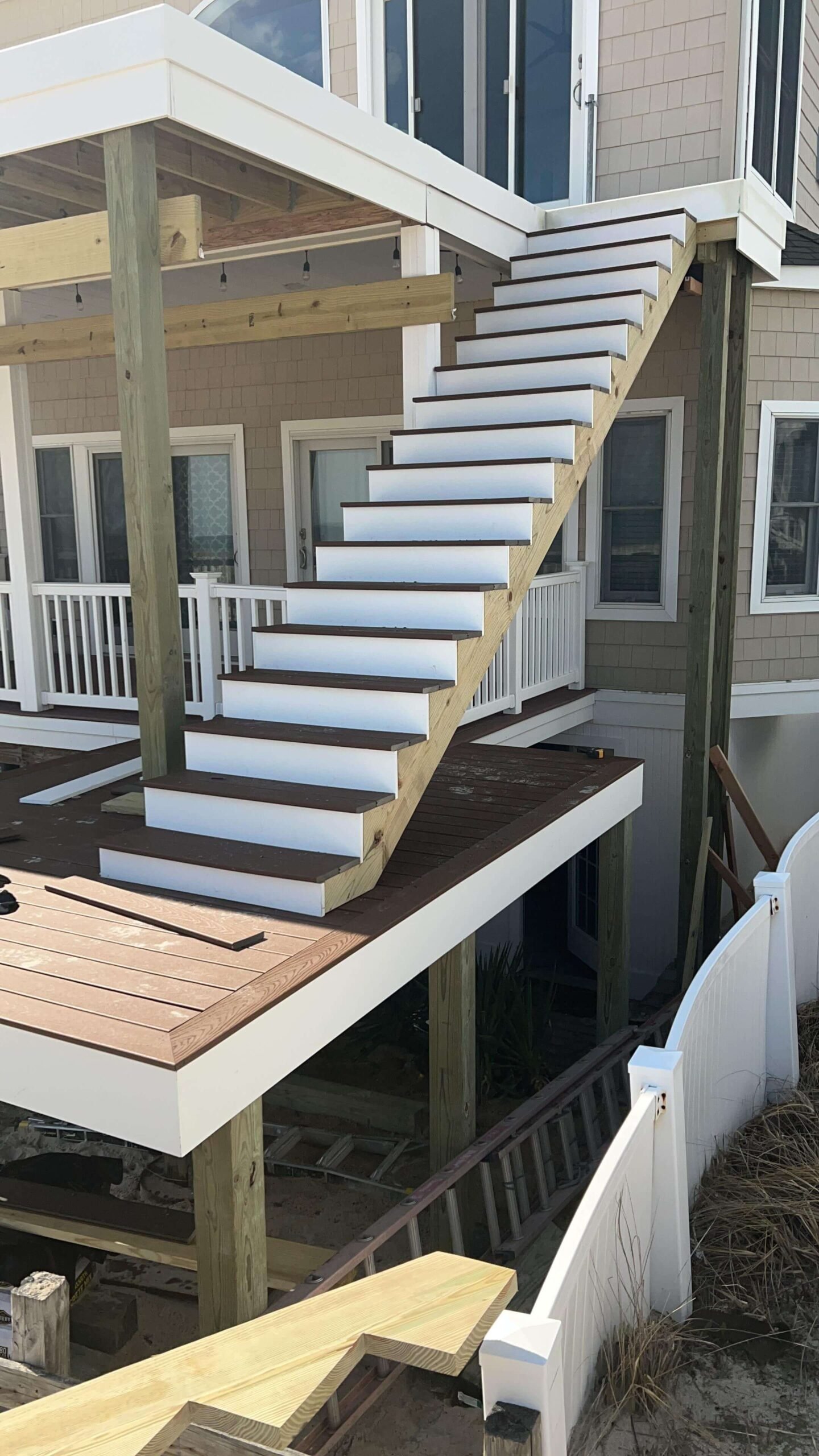
One deck, before and after. Same house, same week.
Where we work
Based in Barnegat and working the island and the mainland around it. A lot of these decks went up when the house did and have not been touched since.
Long Beach Island
Beach Haven, Ship Bottom, Surf City, Harvey Cedars, Barnegat Light, Brant Beach, Beach Haven Crest, North Beach, Loveladies, Holgate, Beach Haven Terrace, Spray Beach, Haven Beach
Southern Ocean County
Barnegat, Manahawkin, Stafford Township, Waretown, Ocean Acres, Tuckerton, Little Egg Harbor, West Creek, Mystic Island
Northern Ocean County
Forked River, Lacey Township, Toms River, Beachwood, Island Heights, Bayville, Seaside Heights, Seaside Park
Questions people ask us
The ones that come up on nearly every estimate.
Do I need a permit to replace a deck in New Jersey?
Yes. New Jersey requires a construction permit for new decks and for replacement decks, and the town does a zoning review along with it. Small repairs — swapping out a few boards, replacing a rail section — generally do not.
We pull the permit and we meet the inspector. If somebody quoting your deck tells you no permit is needed on a full replacement, that is worth a second question, because an unpermitted deck becomes your problem when you sell the house.
What is the minimum depth for deck footings in New Jersey?
Footings have to go below the frost line, which across New Jersey is generally taken as 36 inches, and your town’s building department sets the requirement on your permit. Diameter matters too — a deeper hole that is too narrow does not solve anything.
This is the single most common shortcut on a cheap deck, because once the concrete is poured nobody can tell how deep it went. A shallow footing does not fail in year one. It fails after a few winters when the ground lifts, and by then the deck is out of level and the connections are working loose.
How should I compare deck repair quotes?
Three questions separate two quotes on the same deck faster than anything else. Ask what hardware they are using and whether it is stainless — near salt water the code calls for it. Ask whether they looked at the framing from underneath or only walked on top. And ask what happens, in writing, if they open it up and find more than they quoted.
A quote that is a single number with no scope is not a quote, it is a guess. Ours lists what comes out, what goes back and what is not included, so you can hold it next to anyone else’s line by line.
What does deck repair cost?
Anyone who gives you a number before looking underneath is guessing, and the guess is low on purpose often enough that it is worth being careful about. The same deck can be two completely different jobs depending on whether the frame is sound.
We come out for free, look at it from below, and put the whole scope in writing. If it turns out you need boards and not a rebuild, the quote says boards.
Do you replace just the boards, or the whole deck?
Whichever one your deck actually needs. If the framing and the ledger are solid, new decking and new railing give you something that looks and feels like a new deck without the cost of one, and that is a job we are happy to do.
If the structure is going, new boards on top of it are money spent on appearances. We will show you what we are looking at so you can see the difference yourself rather than take our word for it.
I rent the house out. Can you work around my guests?
Yes, and most of our deck work is on houses that get rented. The honest answer is that the off season is far better for you: nobody loses booked nights, we can get to the job sooner, and there is no pressure to rush the parts that should not be rushed.
If something has to be handled mid-season, tell us what the turnover days are and we will work to them. A deck that is unsafe does not wait for October.
Can you do the work in the off season?
That is when we would rather do it. October through April the house is empty and the schedule is open. Concrete and framing are fine in cold weather; the only thing we watch is staining and sealing, which needs the right temperature and can be scheduled for spring.
The calls all arrive in April, and every year some of them cannot be finished before Memorial Day. Booking in the fall is the difference between having the deck ready and having it ready in July.
Can you also fix the door frame, the trim and the paint while you are here?
Yes. Rot rarely stops at the deck — it comes up through the door frame, the trim and the siding behind the ledger, because it is all getting wet from the same place.
We do doors, windows, carpentry and painting as well, so it can be one crew and one number instead of three contractors who each need to be scheduled and each blame the other two. Tell us everything you want looked at while we are out there.
Are you registered and insured?
Yes. Vega Construction LLC is a registered home improvement contractor with the New Jersey Division of Consumer Affairs, and we carry insurance. The registration number is at the bottom of this page.
New Jersey publishes a public lookup for contractor registrations. We would rather you check it than take our word for it — and we would say the same about anyone else quoting your deck.
How long does a deck job take?
A board and railing replacement on a sound frame is usually a few days. A full rebuild runs longer, and the schedule depends partly on us and partly on the town — footings get inspected before anything goes on top of them, and that inspection happens when the inspector is available.
We give you a realistic window at the estimate rather than the optimistic one, and we tell you where the waiting is going to be.
Do you speak Spanish?
Yes. Hablamos español. Call, text or send photos in either language and you will get an answer in the same one.
What a deck job with us includes
So you know what you are buying before you ask for a number.
A free visit, no obligation
We come out, walk the deck, and get underneath it — because that is where the answer is. If photos are enough to tell you whether it is a repair or a rebuild, that is free too.
An itemised written scope
Boards, framing, stairs, railings and the work around the deck listed separately rather than rolled into one square-foot price — so you can see what you are paying for and compare it against anyone else’s quote.
The structure priced, not assumed
What we expect to find under the boards, and what it costs if we find worse. Agreed before you sign rather than raised once the deck is open.
Permits pulled and inspections met
When the job needs one we pull it and we meet the inspector. That is part of our job, not something you have to manage from wherever you live.
Dates that work around your season
Start and finish dates in writing, planned backwards from your first booking if the house is rented, with progress photos as the job runs.
One person to call, in either language
The same number from the estimate to a year later. English or Spanish, and whoever answers has been on your deck.
What our clients say
A deck is the one thing on the house the whole family stands on at once. This is what the last owners said about ours.
Straight from our Google profile
Not selected, not edited. These are the reviews on our Google Business Profile, shown here as they were written.




Send a photo of the deck
Usually that plus one from underneath is enough for us to tell you what you are looking at. Free estimate, a written scope, and a deck that is still solid in fifteen years.
Vega Construction LLC · New Jersey Home Improvement Contractor · Barnegat, NJ · Serving Long Beach Island and Ocean County